
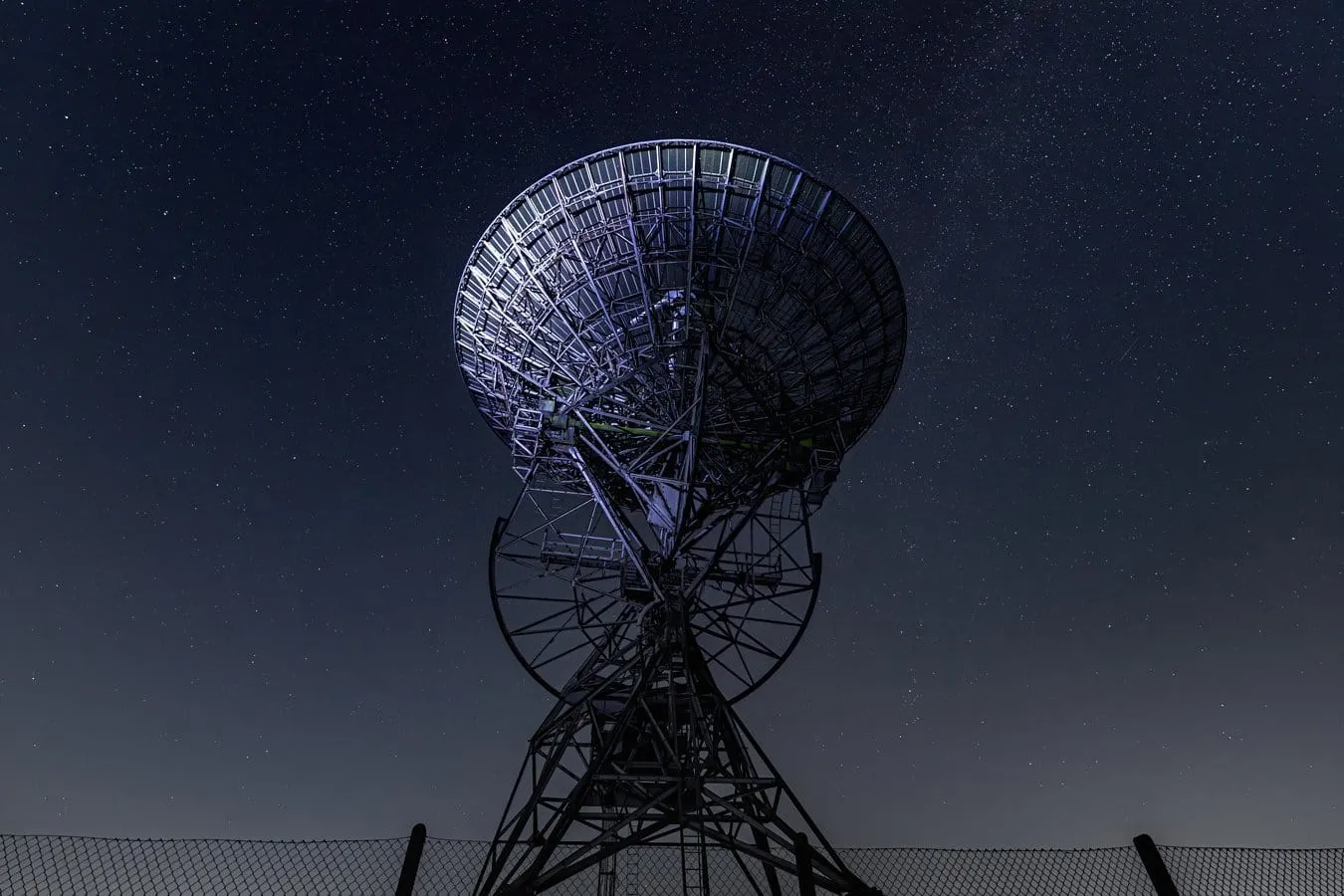
Quick answer: Build a dish farm when the required beams are receivable at your site, demand is steady, and ownership is cheaper over the planned life at the same resilience level. Rent satellite reception when you need another footprint, capacity changes frequently, or you cannot justify operating the RF site. If local reception fails the link budget, the payback calculation never starts.
1. Check the beam before you price the dish
Start with the exact carriers and their beams, not just the orbital position. Satellites at the same position can serve different regions, and carriers at the same site can have very different margins. A coverage map is a starting point; get a usable measurement on your weakest must-have carrier.
2. Budget for a reception site, not just an antenna
Count the mount or foundation, clear view of the arc, safe maintenance access, cable installation, grounding and commissioning. Add the feed, low-noise block downconverter (LNB), distribution and receive hardware. A cheap reflector on a site you cannot service is not a cheap receive system.
3. Count simultaneous demand over the whole contract
Create a normal-day case, an event-day case and a growth case. A permanent bouquet can justify a fixed investment. A second beam for six events a year may not. Estimate active carriers and receiver paths with the tuner sizing guide before comparing equipment with hosted connections.
4. Compare the same delivery boundary
A site quote may stop at an L-band handoff; a hosted quote may include tuning and IP delivery. Put the same output in both columns: for example, selected services delivered to the headend, with the same monitoring and failover requirements. Count any servers, processing and connectivity still needed on your side.
5. Value the people it takes to keep reception live
Put a cost on access, alignments, remote hands, night callouts, spare inventory and fault isolation between RF and IP. Allocate staff time even if the person is already on payroll. The headend cost guide gives those items their own budget lines.
6. Match failure protection on both sides
Two receiver cards downstream of the same LNB will not survive an LNB fault. Two receive sites may still share a transit route. Compare the paths you actually need to survive through antenna, distribution, server, power and IP. Ask the provider what really changes on failover.
7. Include the traffic that leaves each site
At a self-hosted site, circuit, cross-connect and public egress may be new costs. With hosted reception they may be included, metered or billed separately. Use measured bitrate and copy counts to cost the same delivery on each side.
8. Calculate the payback, then stress-test it
Simple payback in months = extra upfront cost to build ÷ monthly saving from building. If building costs at least as much each month and costs more upfront, there is no break-even under those assumptions. For a full investment decision, test lease renewals, equipment replacement, higher staffing costs, residual value and the cost of capital.
9. Keep the profitable part in-house
The choice is not all-or-nothing. Keep a high-utilization local bouquet on your own dishes and bring in a hard-to-reach beam, temporary capacity or a separate backup path over IP. Agree on the failover design before counting the hosted feed as redundancy.
10. Decide what would change your mind
Write a trigger in the business case: for example, 24 months of committed demand or a verified local margin on the weakest carrier. Until that trigger is met, rent the reception you need and measure what would drive a different decision.
Worked example: a 32-month payback
Illustrative costs, not SATLINE pricing. Assume both designs meet the same coverage, handoff and resilience requirements. Monthly costs stay flat; the model excludes taxes, financing and residual value.
| Cost line | Build | Rent |
|---|---|---|
| Upfront | €48,000 | €0 |
| Monthly operating cost | €1,800 | €3,300 |
| Total after 24 months | €91,200 | €79,200 |
| Total after 36 months | €112,800 | €118,800 |
Break-even: €48,000 ÷ (€3,300 − €1,800) = 32 months. At 24 months renting is still €12,000 cheaper; at 36 months building is €6,000 cheaper.
If owned operating cost rises by €500 per month, payback moves to 48 months. Run that sensitivity before committing to a site lease. If hosted reception wins, take the buyer checklist into the quote process.
Frequently asked questions
Can a larger dish make building viable outside the footprint?
A larger antenna can help when a weak but usable signal is present. It cannot make a feed viable where there is insufficient usable signal. Require a link budget and an on-site test on the carriers that matter.
Is colocation the same as renting a dish farm?
No. Colocation can let you own the receivers and rent rack space, power, connectivity and an RF handoff. Hosted tuner access can include operation of the receiver itself. Budget each responsibility explicitly.
Does renting reception buy the channels or their rights?
No. SATLINE supplies reception and transport infrastructure. Authorization to access and distribute content is a separate requirement.
Technical references and tools
About the author
Gleb Sazanov
Project Leader
Gleb Sazanov is an accomplished Chief Technology Officer (CTO) with over 20 years of experience in software development, system architecture, and cloud-based solutions. As the CTO of SATLINE, a leading provider of virtual and colocation services tailored to SATCOM businesses, Gleb drives the company’s technological strategy, fostering innovation and efficiency in data center services. His expertise spans various domains, including DevOps, system scaling, and high-performance infrastructure management. With a deep passion for cutting-edge technologies, Gleb plays a pivotal role in shaping the future of the SATCOM industry.